|
SHIFTING
Snagged in Bar Harbor traffic, I see
at spring’s sunset
a snow-slumped barn squatting
like a fat man, belt cinched tight,
sway-backed as an old nag,
lichened roof punished by a squall.
Beyond the weeping wooden door,
I imagine a flecked, fifty-seven T-Bird
two-tone, white walls, age-bleached ragtop,
a ten-year-old boy pumping the clutch and
working the three-speed on the column,
the engine roaring in his throat.
Seat springs squeaking like new mice,
the wheel knobby as his youthful spine,
he dreams of his own gleaming finish
to the restoration his father abandoned
to the vagaries of middle age,
careering over dreaming highways,
bobbing and pitching on the torn seat,
swerving through endless ess curves,
unformed words not yet his own,
aflame with his devotion to a vision
he will relinquish five years hence
to the gathering fire in his loins. |
|
THE NAKED LADY OF WEST 11TH STREET
Before it fogged with the shower’s steam,
you could stare through the rectangled window
of my late mother-in-law’s bathroom
into the building next door and
sometimes glimpse the naked lady,
dark-haired, thirties, small-breasted, smiling.
My first peek was a Sunday, grey, early November,
she was washing dishes a little after noon.
A naked man, dishcloth draped around his neck
stole up behind her as she rinsed a large platter.
He linked his arms around her waist,
she turned to him, eyes ablaze, lips open,
suds slipping down her arms.
I rubbed the mist from the glass.
She rose on tiptoe,
he held her shoulders and kissed her,
his face shading her smile,
the platter clutched to her chest
obscuring her nipples.
I lathered my hair, my body, rinsed.
Wiping the window with my towel,
I caught the crescents of her flanks,
as perfect as the bouts of a porcelain guitar,
stretching to place the platter in a cupboard,
the naked man admiring their symmetry,
flicking them with the dishcloth.
From the stoop or the fire escape,
I surveyed those who came and went
from the naked lady’s building,
unsure I ever saw her clothed.
I spied her many times again
at the sink, naked, pale, beautiful,
alone, washing and drying
a plate, a knife, a fork, a cup, a wine glass,
never looking over her shoulder,
as if not to jinx love’s return. |
|
NIGHT WIND
Like a child she holds her
breath under a lake, counting
one Mississippi, two Mississippi,
nose pinched between finger and thumb,
sure she can submerge longer than her brother
and his mean friends lying on the float
out beyond where she is allowed
to swim without her father and
yellow life jacket or blue kick board,
out where she knows they are
laughing at her as she surfaces,
sputtering and gulping new
wind into her lungs, unaware
that she prays they will become
frightened by the length of her dive,
and will leap from their backs
and stab their sun-burnished
limbs through the cold water,
like that, like the desire to be rescued
not because you are bleeding
or dangling from a precipice,
but because someone looked for you
and not finding you where you should be
dove into the waves for love. |
|
TRAPPING
I worried the rust off the traps
with wrist and steel wool.
“Set ’em along the bank,” old Ed said,
“where a muskrat might pass,
and check your line twice a day.
Weather’s no excuse for suffering.”
I anchored the steel in winter frost and
through high summer’s flush
tramped the line at first light
and before the dinner bell.
In July, when I’d snared only an unlucky crow,
I abandoned dreams of baled pelts.
Going days without searching the shore
of the sun-shrunk stream,
I deserted my traps for pick-up baseball
and skinny-dipping.
When October’s blood fired the hills
and singed the swamps
and men burned gathered leaves,
the harsh smoke coiling over the woods,
I found in a sprung jaw the dried stalk
of a coon’s gnawed-off leg.
We moved the next year
to a place without woods or a brook,
and I left the traps on the barn wall,
entrusting them to rust.
|




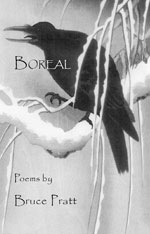 Bruce Pratt was born in Bronxville, New York, and grew up in Connecticut. Having graduated from Vermont Academy in 1969, he attended Franklin and Marshall College, where he majored in Religious Studies, receiving his B.A. in 1972. After a short stint in the furniture industry, he began a two-decade career as a folk and blues singer/songwriter, appearing with many of the finest performers in that genre and touring regularly with Ramblin’ Jack Elliott. In the mid-Nineties, eager to spend more time with his wife and sons, Pratt began a new career as a teacher and coach at John Bapst Memorial, a small private high school in Bangor, Maine. His teams having won five consecutive state outdoor track titles, Pratt has five times been voted Maine State Girls’ Track Coach of the Year. In 2001 he received an M.A. in English from the University of Maine and in 2004 graduated from the Stonecoast MFA program at the University of Southern Maine, where he currently teaches fiction and advanced fiction writing. Pratt’s poetry and fiction have appeared in more than two dozen journals and literary magazines during the past few years and have garnered several awards, among them the 2007 André Dubus Short Fiction Award. On Bloomsday, 2007, he and his wife, Janet, celebrated their thirty-fourth wedding anniversary.